

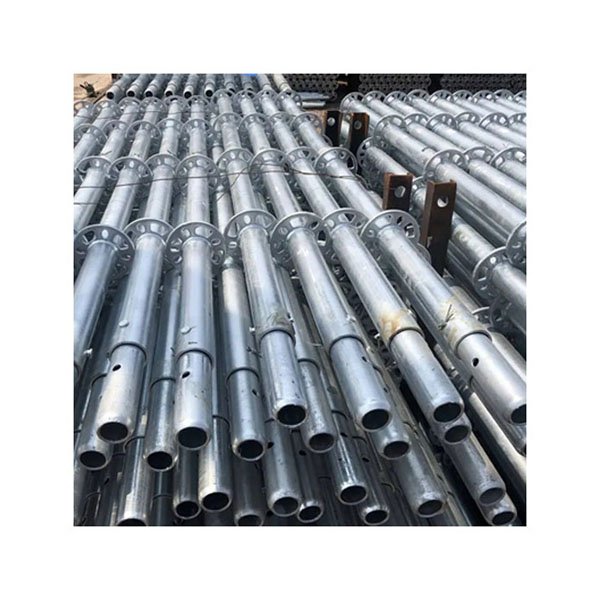
Scaffolding & Accessories
Scaffolding is a temporary load‑bearing working‑platform system widely used in construction and industrial sites. Assembled by steel tubular main members and matching accessories, it provides elevated working space and material support. Four mainstream systems: tube‑and‑clamp, frame(H‑frame), ring‑lock, cuplock. Main steel grades Q235B, Q355B. Surface finishes: hot‑dip galvanized, electro‑galvanized, painted. Hot‑dip galvanizing offers best anti‑corrosion performance. Widely used in building construction, bridges, tunnels, plant revamping, petrochemical maintenance and temporary grandstand/stage erection.
Main system distinctions
‑Tube‑and‑clamp scaffolding: Steel tubes plus clamps, highly flexible for complex geometry. Many components, slow erection, low cost. ‑Frame (H‑frame) scaffolding: H‑shaped frames, fast assembly. For low‑rise finishing and indoor shoring. ‑Ring‑lock scaffolding: Self‑locking disc‑wedge joint, modular design, high erection efficiency and load capacity. Major export item. Two series: 48 series standard, 60 series heavy‑duty shoring北京市住房…. ‑Cuplock scaffolding: Locking cup joint system. Widely used domestically and for some Central‑Asia projects.
Key accessories list
Standards, ledgers, diagonals, disc plates, wedges, connecting collars, base jacks, U‑head jacks, right‑angle couplers, swivel couplers, sleeve couplers, steel planks, access ladders, lock pins, cross braces, tie rods, toe boards.
1. Main Types
1. By material
‑Carbon‑steel scaffolding: Q235B for general works; Q355B for heavy‑load bridge & formwork shoring. ‑Aluminum scaffolding: Light‑weight, for indoor maintenance & mobile access; higher cost.
2. By anti‑corrosion finish
‑Hot‑dip galvanized: Zinc coating 60‑85 μm, superior outdoor weather resistance, preferred for export. ‑Electro‑galvanized: Thin zinc layer, for dry indoor service. ‑Painted: Low cost, poor corrosion resistance, for short‑term domestic projects.
3. Typical dimensions
Ring‑lock standards: Φ48×3.2 mm(standard), Φ60×3.2 mm(heavy‑duty); module lengths 0.5 m /1.0 m /1.5 m /2.0 m /2.5 m. Ledgers: 0.6‑3.0 m modular lengths. Scaffold tube: Φ48.3 mm, wall thickness 2.75‑3.2 mm. Base / U‑head jack: Screw diameter 32‑38 mm. Steel plank: width 240‑300 mm, length 0.6‑3.0 m.
2. Production Process
Steel tube cutting → robotic welding of joints(disc/cup/spigot) → straightening & shaping → deburring → hot‑dip galvanizing / painting → dimensional & weld inspection → bundling & packing.
3. Key Features
‑Ring‑lock system: Self‑locking wedge joint, high joint stiffness, fast erection & dismantling, good safety. Higher initial cost than frame / tube‑clamp, preferred for large‑scale overseas projects. ‑Tube‑and‑clamp: Maximum flexibility for irregular layouts; heavy on‑site labor. Safety heavily depends on coupler quality. ‑Frame system: Standardized parts, simple assembly; poor adaptability for complex shapes. ‑General notes: Temporary structure, over‑loading forbidden. Hot‑dip galvanized performs well for coastal / humid outdoor conditions. Wall thickness, weld quality and screw diameter are critical quality indexes. ‑Limitations: Deformed or cracked components must not be reused. Store dry; galvanized surface will locally rust if scratched.
4. Typical Applications
High‑rise facade works; bridge & tunnel formwork shoring; factory & petrochemical‑plant maintenance; interior‑exterior finishing; temporary grandstands and stages; stacking support. Low‑rise finishing: frame / tube‑and‑clamp. Heavy‑duty large overseas projects: hot‑dip galvanized ring‑lock scaffolding.
5. Standards
‑China: GB 15831 Steel tube scaffold couplers; JGJ 231 Ring‑lock scaffolding; GB 24911 Cuplock scaffolding.
6. Selection Guidance
- General civil works with limited budget: tube‑and‑clamp or frame. Large‑scale overseas heavy‑duty projects: prefer hot‑dip galvanized ring‑lock.
- Material: Q235B for general conditions; Q355B for bridge and heavy formwork shoring.
- For export orders, verify actual tube wall thickness, screw diameter, zinc coating thickness, full accessory list. Require MTC mill‑test certificates and weld inspection reports.
- Export to EAEU: prepare EAC declaration and Russian‑language operation manual.
- Do not use deformed, cracked or under‑thickness components.
Reviews
There are no reviews yet.