

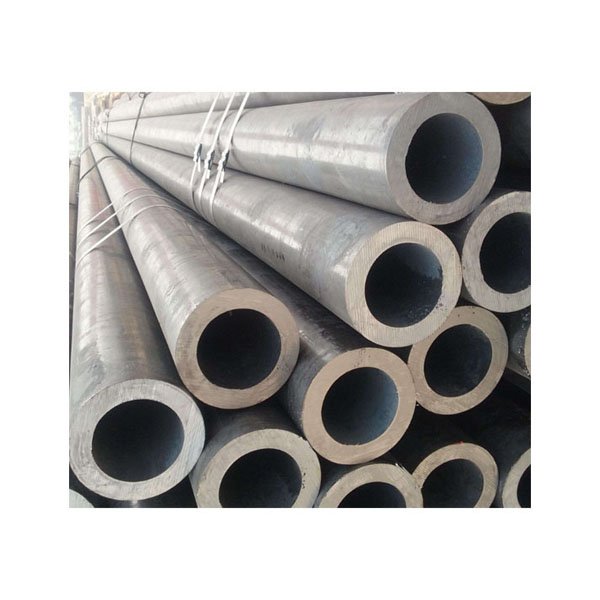
Seamless Steel Pipe
Seamless steel pipe is manufactured from steel ingot or solid billet by hot‑rolling, cold‑drawing or cold‑rolling piercing process. There is no welded seam on pipe body. Uniform metal structure, no weak weld zone, high pressure‑bearing capacity, resistant to high‑pressure, impact and alternating load. Different from ERW / spiral welded pipe, widely used for pressure fluid transmission, boiler‑petrochemical service, mechanical processing, oil‑gas and mining equipment. Dimension notation: Outer Diameter × Wall Thickness (ΦD×S).
1. Main Types
1. By manufacturing process
‑Hot‑rolled seamless pipe: Mainly large‑diameter & heavy‑wall; high output, moderate surface finish; for medium‑high pressure pipelines and structural parts. ‑Cold‑drawn (cold‑rolled) seamless pipe: Small‑diameter & thin‑wall, high dimensional accuracy, smooth surface; for precision hydraulic components and machine parts.
2. By application standard
‑GB/T 8162 Structural seamless pipe: For mechanical structures & components, NOT for pressure‑fluid service. ‑GB/T 8163 Seamless pipe for fluid service: For pressured water, oil, gas; hydrostatic test is mandatory. ‑GB 3087 Low‑medium pressure boiler pipe: Heating‑surface tubes for industrial boilers. ‑GB 5310 High‑pressure boiler pipe: Superheater & reheater tubes for power‑station boilers. ‑GB 6479 High‑pressure fertilizer pipe: High‑pressure chemical pipelines for hydrogen‑nitrogen media.
3. By material
‑Carbon steel: 20# (most common for fluid), 45# (mechanical shafts & sleeves), 10#; ‑Low‑alloy steel: Q355B (16Mn), for low‑temperature & medium‑pressure service; ‑Alloy steel: 15CrMo, 12Cr1MoVG for high‑temperature boilers; ‑Stainless seamless pipe: 304, 316L for corrosive media.
2. Main Components
Pierced from solid billet, no weld seam. Matching seamless fittings: flange, elbow, tee. Connection methods: flange, welding, threaded joint. Inspection items: hydrostatic test, eddy‑current / ultrasonic test, mechanical properties, chemical composition.
3. Key Features
‑No weld seam; excellent pressure resistance, burst‑proof and impact‑resistant; suitable for high‑pressure, high‑temperature and low‑temperature conditions. ‑Wide wall‑thickness range, heavy‑wall pressure‑bearing products available; wide size range from small instrument tubes to large heavy‑wall pipes. ‑Hot‑rolling for high productivity; cold‑drawing for high precision with higher cost. ‑Limitations: higher material cost vs welded pipe at same dimension; poor economy for extra‑large diameter.
4. Typical Applications
Pressurized fluid pipelines, boilers, petrochemical refining equipment; hydraulic cylinder barrels, mechanical shaft parts; oil‑gas exploitation, mining equipment; heat exchangers, high‑pressure process piping. Process flow: Billet heating → Piercing → Hot‑rolling / cold‑drawing → Sizing → Heat treatment → NDT inspection → Finished product.
5. Standards
‑China: GB/T 8162‑2018, GB/T 8163‑2018, GB 3087‑2022, GB 5310‑2017 ‑Russia: ГОСТ 8731‑74 (hot‑rolled technical conditions), ГОСТ 8732‑78 (hot‑rolled dimensions), ГОСТ 8733‑74, ГОСТ 8734‑75 (cold‑drawn)
6. Selection Guidance
- For pressure‑fluid service, use GB/T 8163 fluid‑grade pipe only. Do NOT substitute with GB/T 8162 structural pipe for pressure‑bearing lines.
- Large‑diameter heavy‑wall: prefer hot‑rolled. High‑precision small‑size thin‑wall: choose cold‑drawn seamless pipe.
- Ordinary water‑oil‑gas: grade 20#; mechanical parts: 45#; low‑temperature: Q355B; high‑temperature boiler service: Cr‑Mo alloy steel.
- Pressure‑bearing pipes shall be supplied with hydro‑test and non‑destructive‑test reports.
Reviews
There are no reviews yet.