

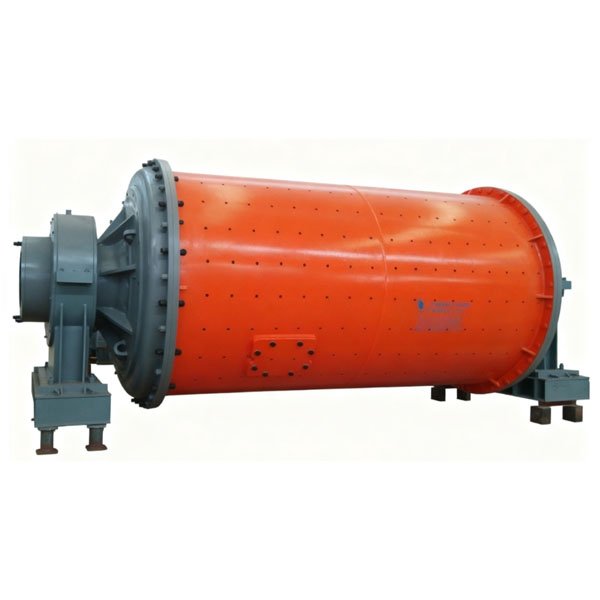
Ball Mill
Ball mill is key grinding equipment for post‑crushing material reduction. Steel balls or cylpebs are loaded inside horizontal rotating drum. While drum rotates, grinding media are lifted and fall down, comminuting ore by impact and attrition抖音百科. Two main processes: wet grinding and dry grinding. Wet grinding dominates mineral processing; dry grinding is widely used in building‑material and chemical industries. Applied in mineral processing, cement, metallurgical slag, refractory, ceramic and powder‑chemical industries. Crushed ore from jaw / cone crusher feeds into ball mill; ground product goes to classification, flotation and downstream processes.
1. Main Types
1. Grate‑Discharge Ball Mill (MQG series)
‑ Principle: Grate liner installed at discharge end for forced discharge, fast slurry flow. ‑ Features: High throughput, low over‑grinding; relatively complex construction, grate liners are wear parts. ‑ Application: Primary coarse grinding in mineral‑processing circuits, high‑capacity duty.
2. Overflow‑Discharge Ball Mill (MQY series)
‑ Principle: No grate plate; slurry overflows by liquid level. Reverse spiral inside trunnion prevents steel‑ball escape. ‑ Features: Simple structure, easy maintenance; finer grinding fineness. ‑ Application: Secondary fine grinding, re‑grinding in concentrator.
3. Dry‑Type Ball Mill (MQ series)
‑ Principle: Material discharged by air conveying, no slurry. ‑ Features: Equipped with dust‑removal system; for water‑sensitive materials. ‑ Application: Cement, refractory material, dry‑powder processing.
Note: Rod mill (MB) uses steel rods as media for uniform coarse product. Tube mill with long cylinder, multi‑compartment for cement grinding.
2. Main Components
Feeding section, rotating drum with shell liners, discharge section, hollow trunnions, main bearings, girth‑pinion gear set, reducer, driving motor, lubrication system. Shell liners, grinding balls and cylpebs are major consumable parts.
3. Key Features
‑ Huge reduction ratio, feeds of tens of millimeters can be ground to mesh‑scale fineness; compatible with ores of various hardness. ‑ Wet grinding offers high efficiency & low dust; dry‑type for materials intolerant to water. ‑ Grate‑discharge for high‑capacity coarse grinding; overflow‑type for fine and re‑grinding. ‑ Heavy equipment with high installed power; continuous consumption of balls and liners, operating cost needs careful evaluation. ‑ Size range: φ900‑φ7000 mm; capacity:0.5‑600 t/h.
4. Typical Applications
Grinding for ferrous & non‑ferrous ore beneficiation; steel‑slag & slag powder production; cement raw‑meal & clinker; refractory raw‑material, quartz‑powder processing. Process flow: Raw ore → Jaw crusher → Cone crusher → Ball‑mill grinding → Hydro‑cyclone / classifier → Flotation / magnetic separation.
5. Chinese Standards
‑ JB/T 1406 Ball mill ‑ GB/T 7679.5 Mining‑machinery terminology‑Crushing & grinding equipment ‑ GB/T 25701 General safety requirements for mining machinery ‑ Russian standards: ГОСТ 10141‑91 Rod and ball mills general specifications; ГОСТ 7524‑2015 Grinding steel balls specifications.
6. Selection Guidance
- Primary coarse grinding, high throughput: prefer MQG grate‑discharge. Secondary fine / re‑grinding: select MQY overflow‑discharge.
- Water‑sensitive material requiring dry powder: choose dry‑type ball mill.
- Coarse feed needs large‑diameter balls; finer finished size requires higher proportion of small balls and cylpebs.
- Reserve 15‑20 % capacity margin to match upstream crushing equipment.
- Wet grinding shall work with classifier (hydro‑cyclone, spiral classifier) to form closed‑circuit grinding for better efficiency.
- Shell‑liner and ball material determine operating cost; high‑chromium wear‑resistant material recommended for hard ores.
Reviews
There are no reviews yet.