

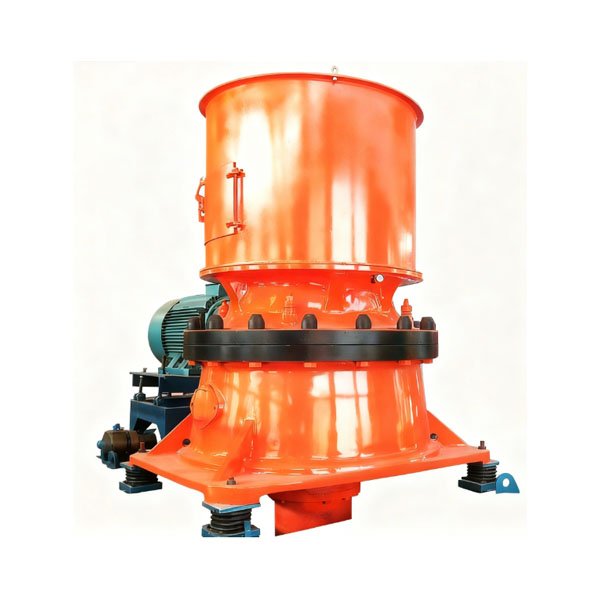
Cone Crusher
Cone crusher is compressive laminating‑crushing equipment, mainly for secondary & tertiary crushing of medium‑hard to hard ores and rocks. Motor drives eccentric sleeve to generate gyratory motion of mantle. Mantle periodically approaches and retreats from concave. Material is crushed by compression, splitting and inter‑particle laminating force between mantle and concave liners, qualified product discharges from bottom gap. Suitable for granite, basalt, river pebble, iron ore, compressive strength ≤350 MPa. Widely used in aggregate, mineral processing, metallurgy and solid‑waste treatment. Usually installed after jaw crusher as secondary or tertiary crushing unit抖音百科.
1. Main Types
1. Spring Cone Crusher (PY series, Symons‑type)
‑ Principle: Spring assembly for tramp‑iron protection; gap adjusted by shims. Standard cavity for secondary crushing, short‑head cavity for fine crushing. ‑ Features: Proven mature structure, common spare parts; low automation level. ‑ Max feed ≤300 mm; capacity:20‑800 t/h. ‑ Application: Small‑medium quarry & mine projects, budget‑limited cases.
2. Single‑Cylinder Hydraulic Cone Crusher (HST / SMG series)
‑ Principle: One bottom hydraulic cylinder completes gap adjustment, overload protection and cavity clearing. ‑ Features: Compact layout, few maintenance points, gap‑adjustment under load, cost‑effective. ‑ Max feed ≤250 mm; capacity:50‑900 t/h. ‑ Application: Secondary crushing for medium‑size production lines, general‑purpose use.
3. Multi‑Cylinder Hydraulic Cone Crusher (HPT / SMS series)
‑ Principle: Multiple hydraulic safety cylinders around frame, high crushing force, PLC intelligent control system. ‑ Features: Excellent laminating crushing effect, high cubic particle percentage, low flaky content; switchable cavities, high automation. ‑ Max feed ≤220 mm; capacity:80‑2000 t/h. ‑ Application: Large‑scale hard‑rock lines, high‑grade aggregate, fine crushing for mineral processing.
Cavity note: Standard cavity: large feed opening, short parallel zone for high‑throughput secondary crushing. Short‑head cavity: long parallel zone for fine crushing & particle shaping.
2. Main Components
Frame, transmission assembly, eccentric sleeve, mantle assembly (mantle liner), concave assembly (concave liner), hydraulic / spring safety system, lubrication system, control system. Mantle and concave liners are high‑manganese main wear parts.
3. Key Features
‑ Laminating crushing principle, large reduction ratio, wide capacity range; suitable for highly‑abrasive hard rock. ‑ Hydraulic models provide tramp‑iron protection, auto cavity clearing, gap adjustment under load, less downtime. ‑ Multiple interchangeable cavities for secondary / tertiary crushing on same machine. ‑ Good cubic‑shaped product, low energy consumption. ‑ Capacity:20‑2000 t/h; maximum feed size up to 300 mm.
4. Typical Applications
Secondary & fine crushing for granite, basalt, river pebble, ferrous & non‑ferrous ore; high‑grade highway & railway aggregate; pre‑grinding preparation in concentrators; metallurgical‑slag processing. Process flow: Jaw‑crusher primary crushing → Cone secondary crushing → Screening → Cone fine crushing → Sand‑making / Ball milling.
5. Chinese Standards
‑ JB/T 2547 Spring cone crusher ‑ JB/T 11187 Hydraulic cone crusher ‑ GB/T 7679.5 Mining‑machinery terminology‑Crushing & grinding equipment ‑ GB/T 25701 General safety requirements for mining machinery
6. Selection Guidance
- Large‑scale hard‑rock line, strict aggregate‑shape requirement: Prefer Multi‑cylinder hydraulic cone crusher.
- Medium‑size line, secondary‑crushing duty, cost‑performance focus: Prefer Single‑cylinder hydraulic cone crusher.
- Tight‑budget small‑medium projects: Spring cone crusher; hydraulic type is preferred for new plants.
- Secondary crushing: choose Standard cavity; fine crushing & shaping: choose Short‑head cavity.
- Even full‑choke feeding is required; uneven / insufficient feed worsens particle shape and accelerates wear.
- Reserve 20 % capacity margin to match upstream jaw‑crusher output.
Reviews
There are no reviews yet.