

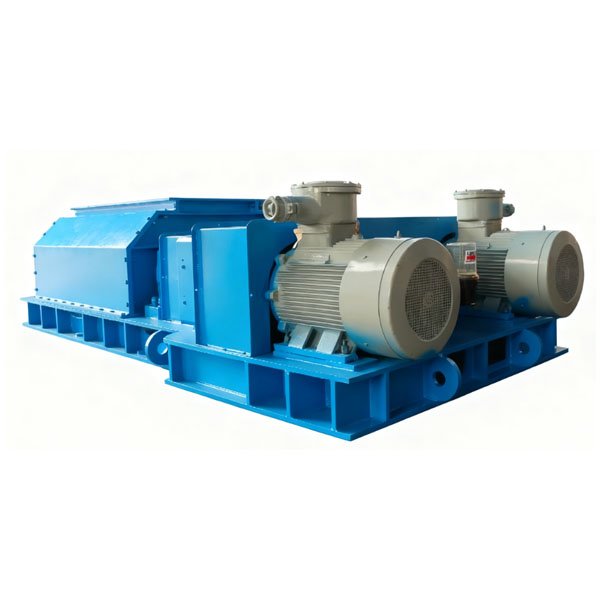
Double‑Roll Crusher
Double‑roll crusher is compression‑type secondary & fine crushing equipment. Two horizontal rolls rotate toward each other. Material is drawn into roll gap by surface friction and crushed by compression and attrition. Movable roll is equipped with spring or hydraulic tramp‑iron protection; when un‑crushable hard objects enter, movable roll yields automatically to protect main machine. Product size is controlled by adjusting roll gap. Suitable for ores & rocks with compressive strength ≤300 MPa. Low over‑crushing, uniform product size. Widely used in mining, sand‑making, coal, metallurgical slag, building materials and refractory industry.
1. Main Types
1. Spring Double‑Roll Crusher (2PG series)
‑ Principle: Spring assembly for tramp‑iron protection; gap adjusted by shims or wedge blocks. ‑ Features: Simple structure, low cost, easy maintenance, for small‑medium capacity. ‑ Max feed ≤85 mm; capacity:5‑100 t/h. ‑ Application: Crushing coal, coke, limestone, sinter for small‑medium plants.
2. Hydraulic Double‑Roll Crusher (2PGY series)
‑ Principle: Hydraulic cylinders for gap adjustment and overload protection; gap adjustable under load. ‑ Features: High crushing force, stable gap setting, high automation; heavy wear‑resistant roll shells, ideal for hard‑rock sand‑making. ‑ Max feed ≤120 mm; capacity:30‑400 t/h. ‑ Application: Sand‑making from river pebble, quartz, iron ore; large‑medium quarry & mineral‑processing projects.
3. Four‑Roll Crusher (4PG series)
‑ Principle: Two sets of double‑roll in series, completes secondary and fine crushing in one pass. ‑ Features: Very fine finished product in single stage, simplifies process flow. ‑ Application: Fine crushing for coke, refractory raw materials, sinter.
Roll‑surface types: Smooth roll shell: compression crushing for hard‑rock sand‑making. Toothed / grooved roll shell: good bite for lump feed, for brittle materials such as coal and shale.
2. Main Components
Machine frame, fixed‑roll assembly, movable‑roll assembly, wear‑resistant roll shells, spring / hydraulic safety unit, roll‑gap adjusting device, motor‑reducer drive, safety guard. Roll shells are key wear parts, made of high‑manganese steel or hard‑facing alloy; reversible for extended service life.
3. Key Features
‑ Compression crushing principle, low over‑crushing rate, uniform cubic‑shaped product; low noise & dust emission. ‑ Spring / hydraulic tramp‑iron protection with automatic yielding; convenient gap adjustment, output size 1‑40 mm adjustable. ‑ Compact layout, light machine weight, low operation‑maintenance cost; tolerates moderately‑moist feed. ‑ Not suitable for oversize lumps; feed size limited by roll diameter; highly‑sticky materials tend to stick on rolls. ‑ Capacity:5‑400 t/h; maximum feed size up to 120 mm.
4. Typical Applications
Secondary & fine crushing for limestone, river pebble, quartz, iron ore, coal, coal gangue, coke, steel slag, sinter; production of manufactured sand & chip stone; preparation of refractory raw materials. Process flow: Jaw‑crusher primary crushing → Screening → Double‑roll fine crushing / sand‑making → Product screening.
5. Chinese Standards
‑ JB/T 10993 Double‑roll crusher ‑ GB/T 7679.5 Mining‑machinery terminology‑Crushing & grinding equipment ‑ GB/T 25701 General safety requirements for mining machinery
6. Selection Guidance
- Hard‑rock sand‑making, large‑medium projects: Prefer Hydraulic double‑roll crusher.
- Coal / coke processing, budget‑limited small‑medium projects: Adopt Spring double‑roll crusher.
- Two‑stage crushing in single machine: Choose Four‑roll crusher.
- Hard rock: select smooth roll shell; brittle materials like coal & shale: select toothed roll.
- Iron‑removal before feeding is mandatory; lump iron will damage roll shells. Feed size shall not exceed 1/2‑2/3 of roll diameter.
- Exercise caution with highly‑sticky material to avoid roll‑coating; adjust gap or hard‑face repair when roll shells are worn.
Reviews
There are no reviews yet.